
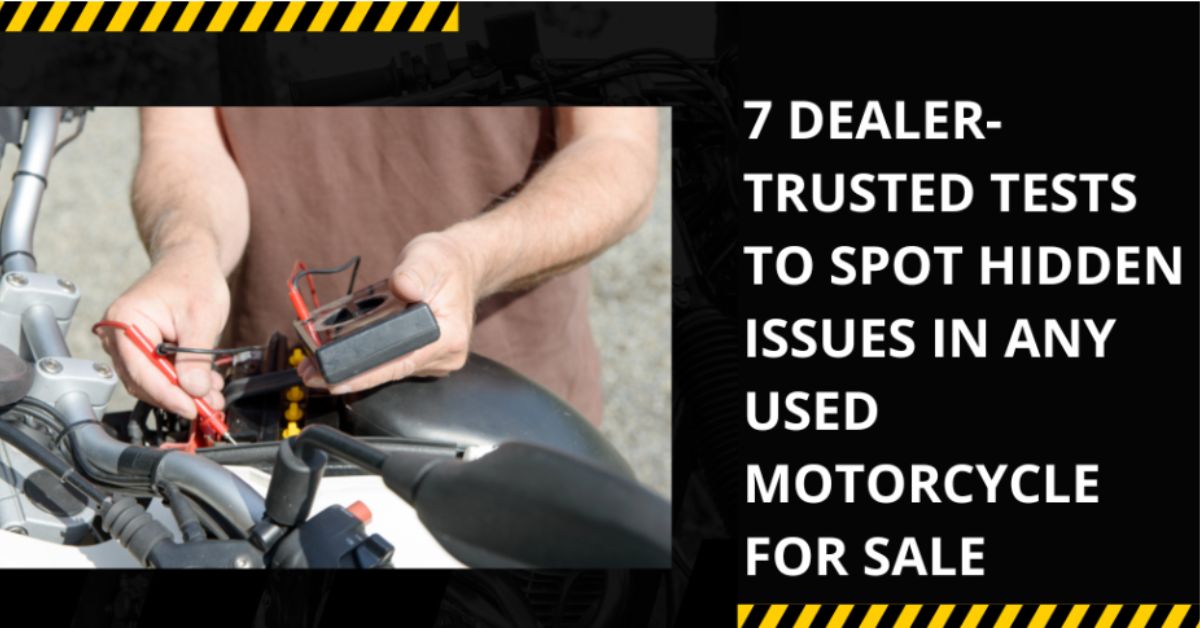
After decades of inspecting motorcycles that have seen everything from long highway miles to hard track days, I can tell you one thing that no two bikes age the same way.
There is a lot beyond checking just the paint, tires, or mileage before you buy or evaluate a used motorcycle. True condition lies in the compression, alignment, and structural integrity that the naked eye can’t see.
To know these, we need to go for paid diagnostic tests. These are scientific checks that can tell you whether a bike’s engine is still healthy.
Here’s a deep look at the tests that can tell you what a visual inspection simply cannot.
1. Compression and Leak-Down Test
A compression test checks how much pressure builds up inside each cylinder. If one cylinder shows lower pressure than the rest, it’s like finding a weak heartbeat. It could mean worn piston rings, leaky valves, or even a cracked head gasket.
Then, the leak-down test, which pushes air into the cylinder to find where it escapes. If you hear it hissing through the intake, the exhaust, or the crankcase, you know exactly where the problem is.
Dealers use these tests because test reports don’t lie, as even a freshly cleaned engine cannot hide this internal wear and tear.
2. ECU Diagnostic Scan
Motorcycles today are smarter. They record every sensor misfire, every over-rev, and sometimes even crash data.
Being so, mechanics now read the ECU’s memory by using an OBD-II or MotoScan diagnostic tool. This will report about the bike’s misfiring injector, an ABS fault, or an overheating part during a long trip.
And if you have seen any motorcycle under, “Used Motorcycle for Sale” and thought why some motorcycles look more trustworthy, it is because the seller included a clean diagnostic report. And this data gives confidence to the buyer!
3. Frame Alignment and Measurement
Do you know? A used motorcycle can look flawless to our naked eye and still be bent.
Motorcycle dealers use laser alignment and digital measurement tools to check this. They compare whether the chassis geometry matches factory specifications.
This is too scary because if a frame that’s even a few millimeters off can cause wobbling at high speeds or uneven tire wear.
So, if you’re buying a sport or adventure motorcycle, this test is a must.
4. Paint Thickness Gauge
This small tool measures the paint layer in microns. Factory paint will always be uniform, usually 100 to 150 microns. But when an area reads higher, it is a sign of hidden repairs or filler beneath the surface.
So, dealers scan the tank, fairings, and frame joints with this tool to look for repainted accident zones. It is such a quick, precise, and brutally honest test.
5. Borescope Inspection
This tool is like slipping a tiny camera into your bike’s engine that can reveal what compression numbers cannot. They report on scored cylinder walls, burnt valve seats, or corrosion hiding deep inside.
This is especially valuable for performance bikes like the BMW S1000RR or Ducati Panigale, where even a fine scratch can affect throttle precision or compression balance.
Also, this is a favorite among seasoned motorcycle dealers because it turns mere assumptions into visual proof.
6. Advanced Imaging (Ultrasound and Laser Scanning)
These are the heavy tools mostly used by high-end shops or certified BMW centers.
Ultrasound testing detects microscopic cracks in metal that even an X-ray might miss. Laser scanning, on the other hand, maps the factory blueprints of the motorcycle to the entire frame in 3D.
If a motorcycle has been in a collision, professionals use this tool to know whether it was repaired correctly or just repainted and polished for resale.
7. Professional Road Test
A trained mechanic or dealer can feel problems that machines cannot measure, like slight handlebar pulls, brake pulsations, or strange vibrations during acceleration.
If the bike pulls slightly left, shakes under braking, or feels “off balance,” they don’t feel right. They doubt for a minor alignment or something serious like frame distortion.
What I Tell Every Rider
After years of evaluating, I have learned that every used motorcycle hides some flaws, some mechanical, some emotional.
- If you are inspecting a touring or adventure bike, always start with frame measurement and leak-down tests. Long-distance machines carry weight and stress that slowly warp geometry.
- If it is a sport bike, go for borescope inspections and paint thickness checks, because there may be a hidden crash history to hide.
- If it is classic and cruiser, you should prioritize compression and corrosion checks, as city commuters often benefit most from ECU scans and road tests to spot sensor fatigue and clutch wear.
And my advice is, paid tests might sound excessive, but they are the reason professional BMW motorcycle dealers in Florida sleep easily after every sale.
So, if something feels too cheap, it is probably hiding a story. Trust the numbers and data, not the shine and polish!
ALSO READ:Keep Your Diesel Engine Running Strong: Maintenance Must-Knows